Are Consumers Myopic? Evidence from Handset and Mobile Services
Single-authored. Published in the Journal of Industrial Economics.
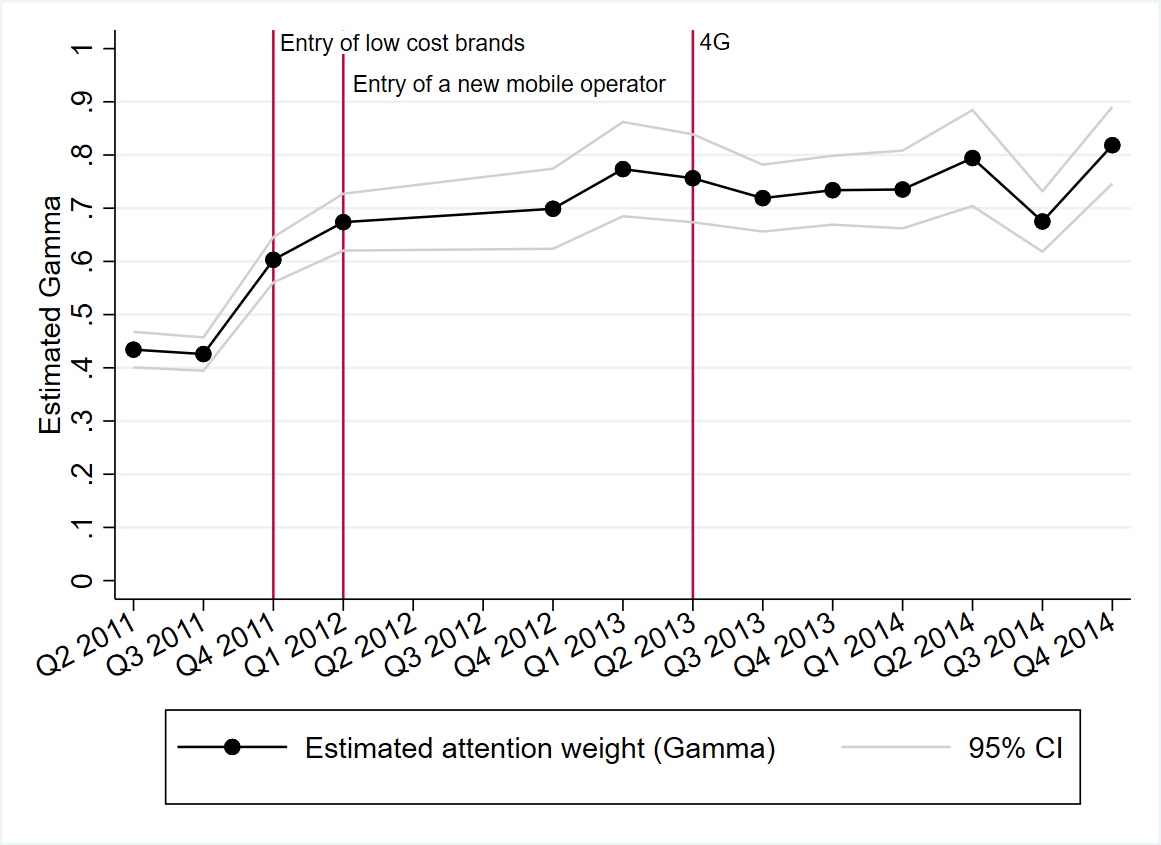
In this paper, I estimate discrete choice models for the joint selection of handsets and mobile tariffs, using data on 10,738 subscribers of a European mobile telecommunications operator observed between April 2011 and December 2014. The estimates are used to compute an attention weight on future recurring tariff payments, measured relative to the upfront handset cost. I interpret this weight as a “revealed-choice” measure of consumer myopia. The results show that consumers substantially underweight future costs on average, with heterogeneity across consumer groups and, more importantly, over time. The average attention weight increases sharply during the period studied, coinciding with the diffusion of SIM-only tariffs and the entry of a new competitor. These market changes affected prices and variety, but also increased the salience and transparency of total contract costs. Counterfactual simulations show that consumer welfare gains come from both the decline in tariff prices and the availability of SIM-only offers. The price decline accounts for a large share of the gains, while SIM-only tariffs provide additional welfare gains by expanding the choice set. Comparing the estimated attention weights with a full-attention benchmark further shows that consumer underattention shapes predicted choices.